 Michael Turner
Key Takeaways
- Use the Monogram range child safety lock every time the range is idle, not only when you remember.
- On touch controls the notice describes holding the lock button for three seconds until the indicator lights; confirm in your manual.
- On knob controls, knob covers are an aftermarket option, and knobs that pull off are a swallowing risk.
- Rear burners, pot handles turned inward and no unattended children matter more than any feature.
- A lock that will not engage or release needs a service visit, and until then it cannot be relied on.
The Bottom Line
Switch the lock on every time, check your manual for the exact steps and keep the cooking habits that do not depend on a feature. If the lock fails or a burner switches on by itself, book a visit; the price is confirmed after diagnosis, with a written estimate before work begins.
Most kitchen accidents with a range happen in a few seconds: a knob turned by a small hand, a burner switched on by a pet, a pot handle that sticks out over the edge. A Monogram range or cooktop has features meant to reduce those risks, and the Monogram range child safety lock is the first of them. The lock is only useful if it is switched on, and it only helps if it is combined with habits that do not depend on a feature. This guide follows the Monogram range and cooktop child safety lock notice on this site and adds the practical steps around it.
| Risk | What reduces it | Where it is described |
|---|---|---|
| A child reaches the controls | The control lock, switched on when the range is idle | Your owner's manual for the exact steps |
| Knobs pulled off or turned | Aftermarket knob covers on knob-style controls | The safety notice |
| A child reaches a hot pan | Rear burners, pot handles turned inward | The safety notice |
| A burner or oven switched on by accident | Lock engaged, everyone in the house reminded | The safety notice |
| The lock will not engage or release | A service visit for the controls | The safety notice |
How Do You Turn On the Monogram Range Child Safety Lock?
Look in your owner's manual first, because the lockout differs between models. The notice says to consult the manual to find the control lock or lockout feature for your specific model, and it gives the usual pattern for electronic touch controls: press and hold the designated lock button, typically labeled Lock or marked with a padlock icon, for three seconds until the lock indicator lights. We do not know the exact button on your model, and we would rather you check the manual than rely on a general description.
- Find the lock button. It is usually labeled Lock or shown as a padlock.
- Hold it for three seconds. The notice says until the lock indicator illuminates.
- Confirm the indicator. A lit indicator is the sign that the controls are locked.
- Try a control. Press a key, with no burner on, to see that the panel ignores it.
What If Your Range Has Knobs Instead of Touch Controls?
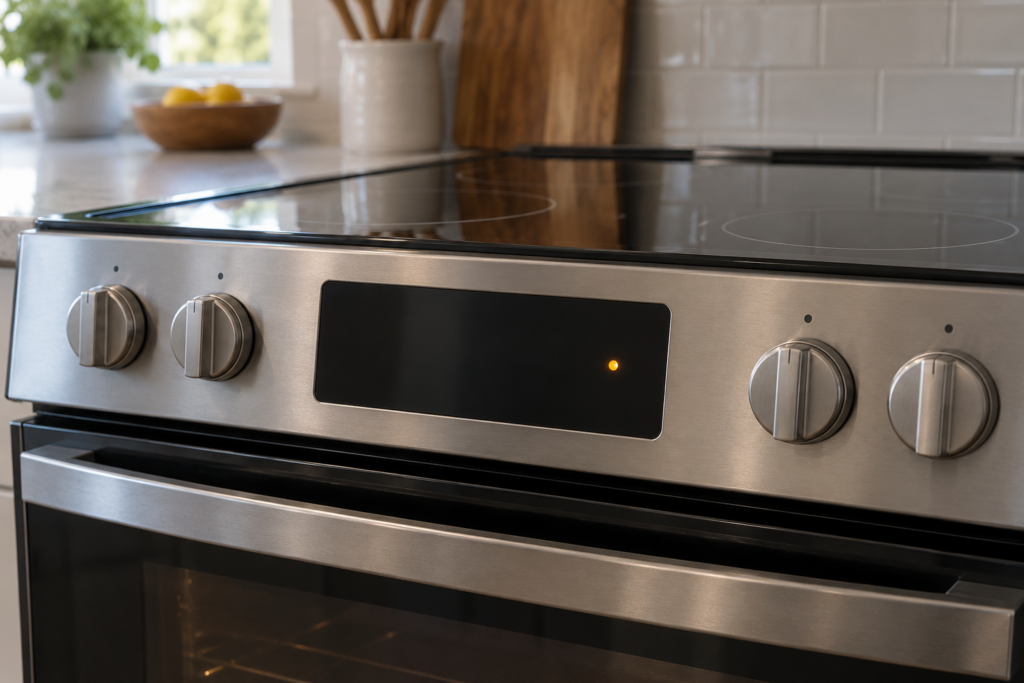
Then the lock is physical, not electronic. For knob-style controls the notice says knob covers are available as an aftermarket safety accessory to prevent accidental rotation. It also lists, among its risk indicators, knobs that can be pulled off and potentially swallowed, which is a reason to check that knobs sit firmly and to replace one that has loosened.
- Knob covers. An aftermarket accessory that stops a knob from being turned.
- Loose knobs. A knob that pulls off easily is a swallowing risk for a small child.
- Pets. The notice lists controls accidentally activated by a pet as a risk too.
Choose covers made for range knobs, and test that the burner cannot be turned with the cover fitted. Avoid anything that makes the knob hard for an adult to turn off in an emergency.
Risk Signs to Act On
Act on any of the four that the notice lists, because each describes a way a burner or an oven ends up on without an adult choosing it. A burner or oven that was found on when no adult turned it on is the strongest sign, and it deserves a look at the controls as well as the lock.
- Young children who can reach the controls. Turn the lock on every time, not only when you remember.
- Controls activated by a child or pet. Switch on the lock and check that the knobs are secure.
- A burner or oven found on. Treat it as a control fault until proven otherwise.
- Knobs that come off. Replace or secure them.
What Else Should You Do While Cooking?
Use the habits the notice lists, because no lock helps while the range is in use. Never leave young children unattended in a kitchen where the range or cooktop is on, cook on the rear burners when children are present and turn pot handles inward so they do not hang over the front. Tell everyone in the house to engage the control lock when the appliance is not in use, because a lock that only one person uses is a lock that is often off.
- Rear burners first. They are the hardest for a child to reach.
- Handles turned inward. A handle over the front edge is an invitation.
- Everyone uses the lock. Agree it as a house rule, not a personal habit.
A lock is also a reminder to look at the room as a whole. Keep the front of the range clear of anything a child might climb, keep matches, lighters and oven mitts away from the cooktop and teach older children to ask before they use it. None of this is in the notice, and none of it replaces the lock, but together they cover the moments when the lock is off because someone is cooking.
What If the Lock Does Not Work?
Then the controls need a service visit, and the notice says so: if the control lock feature does not activate or deactivate as expected, or if controls appear to be malfunctioning, have the range or cooktop serviced. Until then, treat the lock as unreliable, keep children out of the kitchen while the range is on and consider switching the range off at its breaker when it is not in use. Do not use an unlocked range in a household that depends on the lock.
The cause could be the touch panel or the board behind it, and a technician can tell which. Tell them what happens when you hold the lock button, whether the indicator lights and whether the controls respond when they should not.
Think about who else uses the kitchen. Grandparents, babysitters and guests rarely know a range has a lock, and the person who knows should show them where the indicator is and how to release it for cooking. A lock that nobody else can operate tends to get switched off for good, and the safest setup is one that everyone in the house understands and can use in a few seconds.
- Show visitors the lock. A short demonstration beats a note on the fridge.
- Re-lock after cooking. Make it the last step, like switching off the light.
- Review it when children grow. A lock suits a toddler; older children need rules as well.
Where This Fits with the Rest of Range Safety
The lock is one layer of several. Our Monogram gas range safety guide covers the gas-specific risks, and the cooktop safety guide covers the surface itself. Range repair covers control and lockout faults. A diagnostic visit is from $120, with the price confirmed on site after diagnosis and a written estimate before work begins. Schedule a visit or contact us if the lock fails or a burner has come on by itself.