 Michael Turner
Key Takeaways
- After a spill, turn every knob off first; a liquid can put out the flame while the gas keeps flowing.
- If you smell gas, ventilate, avoid flames and electrical switches, and leave and call the gas utility if the smell persists.
- Clean only when the cooktop is cool, clear the ports with a soft tool and never use metal skewers.
- Dry every part completely and wipe the igniter with a dry cloth; moisture causes clicking and failed ignition.
- A burner that is still uneven or will not light after cleaning needs a technician.
The Bottom Line
Shut the gas off, ventilate, let the cooktop cool and then clean and dry the burner before relighting one burner at a time. If it still clicks, burns unevenly or you smell gas, stop and book a technician; the price is confirmed after diagnosis with a written estimate before work begins.
A pot boils over, a kettle tips or a sauce spits across the cooktop, and the first thing that happens is that a gas flame goes somewhere it should not, or goes out while the gas keeps flowing. What you do in the next minute matters more than the cleaning that follows. This guide covers what to do with a Monogram gas burner after a spill: the immediate safety steps, how to clean the burner without damaging it, how to tell when it is safe to light again and which signs mean the burner or igniter needs a technician rather than a cloth.
| What you see after the spill | What it means | What to do |
|---|---|---|
| Smell of gas, flame out | Gas may be escaping | Turn knobs off, ventilate, leave if it persists |
| Burner clicks but will not light | Wet or dirty igniter or ports | Cool, clean and dry the parts |
| Yellow-tipped or uneven flame | Residue in the burner ports | Clean the ports gently |
| Only part of the ring lights | Blocked ports | Clear with a soft tool, never metal skewers |
| Still wrong after cleaning | Igniter or burner assembly fault | Stop and book a technician |
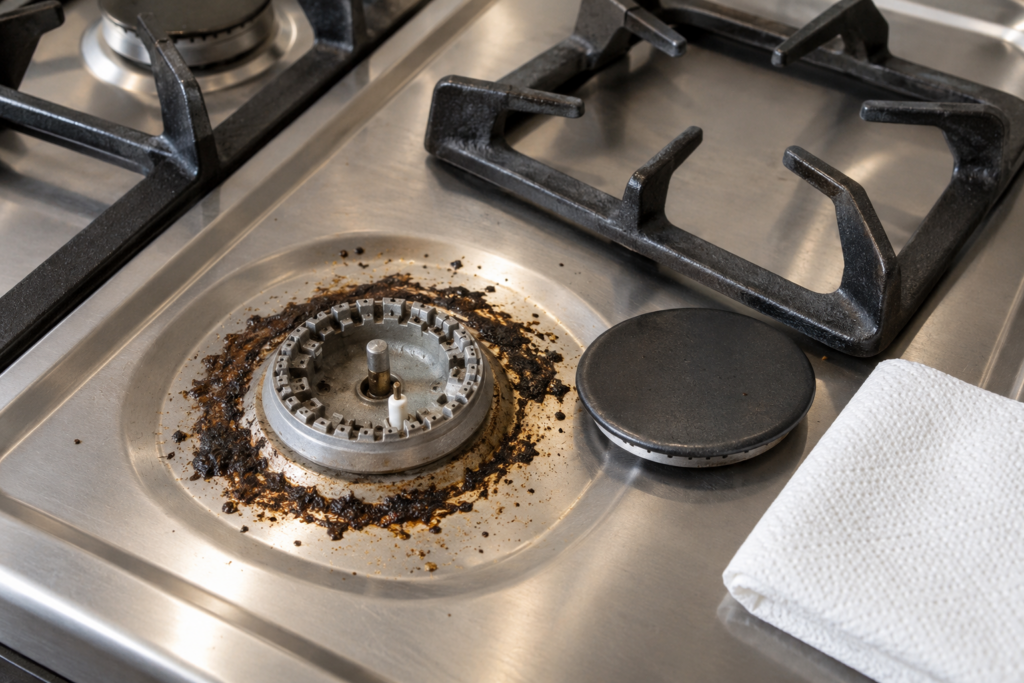
What Should You Do First After a Spill on a Gas Burner?
Turn every burner knob off, and if you smell gas, open a window and keep sparks and flames away. The spill itself can wait; the gas cannot. A liquid that reaches a burner can extinguish the flame while the gas supply stays on, and gas that is released into a kitchen is the danger, not the mess.
- Knobs to off. All of them, not just the burner that was spilled on.
- Ventilate. Open a window or door and run the range hood if it is safe to reach.
- No flames, no switches. Do not light anything or flip electrical switches if you smell gas.
- Leave if the smell persists. Call your gas utility from outside the house.
The gas valve safety notice lists the signs of a gas leak, including a sulfur odor near the range and a hissing sound, and says to evacuate, avoid electrical switches and call the gas utility.
How Do You Clean a Gas Burner After a Spill?
Only after everything has cooled completely, and in the order the notice on this site describes. The spilled liquid safety notice says to turn off the burners, let the cooktop cool, remove the grates, lift off the burner caps and heads and clear the ports with a soft brush, toothpick or a straightened paper clip. Never use metal skewers or abrasive tools, which can enlarge the ports and spoil the flame.
- Remove the grates, caps and heads. They are usually removable without tools.
- Clear the ports gently. A soft brush or a toothpick is enough for most residue.
- Wipe the igniter electrode with a dry cloth. The notice says not to put water directly on it.
- Dry every part completely. Moisture in the burner causes continuous clicking or a failure to ignite.
Why Do Sugary and Starchy Spills Cause More Trouble?
Because they leave a residue that hardens. Water evaporates, but a sauce, a syrup or a starchy boil-over dries into a crust that blocks ports and coats the igniter, so the burner works until the residue sets and then behaves oddly. The notice singles out sugary and starchy liquids for exactly that reason.
That is also why cleaning soon pays off. A spill wiped up after the cooktop has cooled is easy; the same spill baked on by repeated use turns a quick clean into a long one. Our guide to a Monogram cooktop igniter that keeps clicking goes through the cleaning and reseating of the burner cap in detail.
When Is It Safe to Light the Burner Again?
When there is no smell of gas, the parts are clean and dry and the cap sits flat. Test each burner on low and watch the flame: it should be even and blue, all the way around the ring. A flame that is yellow-tipped, uneven or lit on only part of the ring is a sign that the ports are still blocked or the cap is not seated.
- Light one burner at a time. On low, with your face away from the cooktop.
- Look for an even blue flame. Around the whole ring.
- Do not keep clicking if it will not light. Turn the knob off, wait and recheck the cap and the dryness.
- Stop at any gas smell. Turn the knobs off and ventilate.
Preventing the Next Spill
Most spills on a gas cooktop come from the same few habits, and most of them are easy to change. A pot filled to the brim and left on a high flame will boil over sooner or later, a handle that sticks out past the edge invites a knock and a lid left slightly off lets foam climb the side. None of it needs special equipment.
- Fill pots about two thirds full. Starchy water foams and rises.
- Turn handles inward. Away from the edge and from other burners.
- Lower the flame when the pot comes to the boil. A simmer rarely boils over.
- Wipe up small splashes the same day. Once the grates are cool.
- Clean the burner caps and ports regularly. It keeps small spills from becoming blockages.
It also helps to know where the gas shut-off valve is before you need it. The notice on gas valve checks says to know its location in advance, and a valve that is stiff or stuck should be serviced. After a spill that put a burner out, that knowledge turns a worrying minute into a calm one. Teach everyone who cooks in the house the same first step, which is knobs off and a window open, because the person standing at the cooktop when a pot boils over is not always the one who knows the kitchen best.
When the Burner Needs a Technician
When cleaning and drying do not fix it. The notice says that if burners continue to produce uneven flames, fail to ignite or the igniter keeps clicking after thorough cleaning, the igniter or the burner assembly may need professional service. The rangetop code pages, such as E1 for a burner ignition failure, describe the same fault from the display side.
Any smell of gas that is not explained, any sign of a leak at the valve or any burner that lights unpredictably is a stop sign, not a cleaning problem. The Monogram cooktop safety guide covers the wider routine. A diagnostic visit for a Monogram appliance starts from $120, with the final price confirmed after diagnosis and a written estimate before any work begins.
To arrange one, schedule a visit or read about Monogram cooktop repair.