 Michael Turner
Key Takeaways
- A reliability ranking is a survey of reported repairs over a fixed window, which says little about a built-in at year eight.
- Six signals are checkable by the owner: condenser condition, run time, temperature stability, door seal, unexpected frost, and a change in noise.
- Serviceability belongs in the same conversation as failure rate — a repairable design costs its owner far less than a sealed one.
- Installation quality separates built-ins that last from ones that do not, and it appears in no ranking anywhere.
- A badly installed machine produces faults that look like component failures, so clearance is worth checking before parts are suspected.
The Bottom Line
Rankings are one input and a short-window one at that. The condenser, the run time, the seal and the clearance around the cabinet tell you more about the machine in your kitchen than any list, and all four are things you can check yourself this week.
Every year a fresh crop of rankings tells you which refrigerators are dependable and which are not, and every year the lists disagree with each other. That is not because one of them is dishonest. It is because reliability is not one number, and the things that go into it are measured in very different ways. This guide is about what those measurements actually are, and which of them you can verify yourself on the machine already standing in your kitchen.
| Signal people judge by | What it really measures | Can an owner check it? |
|---|---|---|
| Survey scores and rankings | Reported problems in a sample, over a set window | No — but the method is worth reading |
| Service call rate | How often a unit needs a technician | Partly, from your own history |
| Parts availability | Whether a repair is possible years later | Yes |
| Design serviceability | How much has to come apart for a common repair | Yes, by looking |
| Run time and cycling | How hard the system is working to hold temperature | Yes, by listening and measuring |
| Installation quality | Airflow, leveling, clearance | Yes |
What a Ranking Is and Is Not
A reliability ranking is almost always a survey result. A publication asks owners whether their appliance has needed a repair in a given period, groups the answers, and prints the order. That tells you something real, and it also carries limits that rarely make it into the headline.
The first limit is the window. A three-year or five-year figure says nothing about year eight, which is when built-in refrigeration usually starts asking for money. The second is the mix: a brand that sells mostly freestanding units and a brand that sells mostly built-ins are not being asked the same question, because the machines are not doing the same job. The third is that a survey counts repairs, not causes. A unit installed in a tight cabinet with no clearance produces service calls that get recorded against the appliance.
None of this makes rankings useless. It makes them one input, best read alongside things you can check directly — which is where built-in refrigerator reliability stops being an argument about brands and becomes a set of observations about a specific machine.
Six Things You Can Verify Yourself
These are in the order we would look at them on a service visit, and all of them are available to an owner with a flashlight and a thermometer.
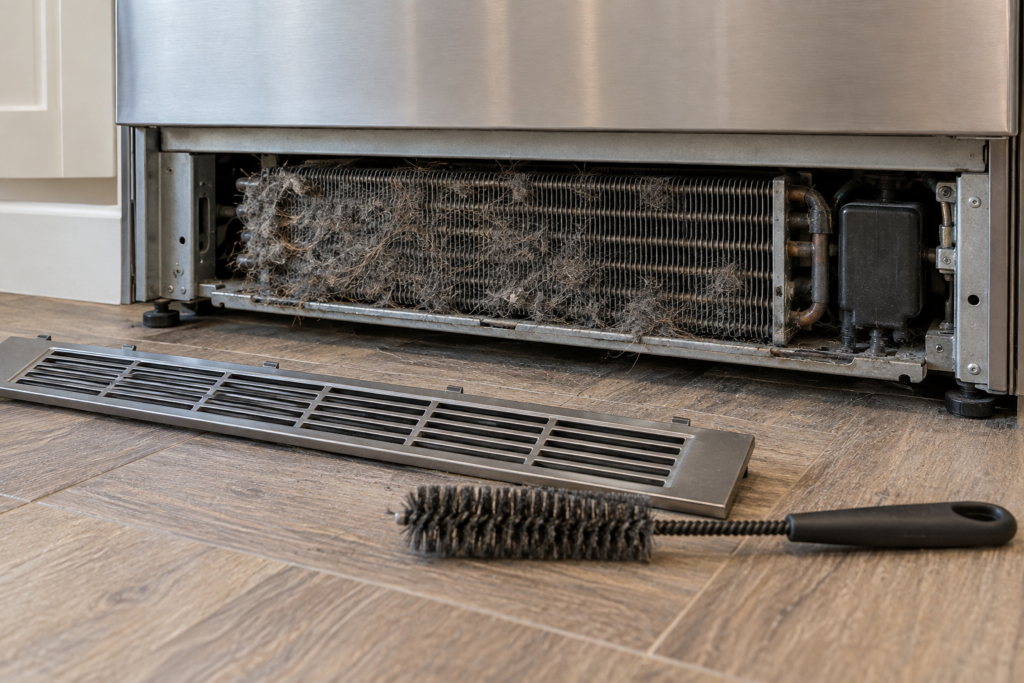
- Condenser condition. Pull the lower grille and look. Fins packed with dust and pet hair mean the system has been working harder than it should for a long time, and that shows up later as a compressor complaint.
- Run time. A healthy built-in cycles. One that runs continuously in an ordinary kitchen is losing ground somewhere, even if the temperature still looks correct today.
- Temperature stability, not the setpoint. Put a thermometer in a glass of water on a middle shelf and read it morning and evening for three days. Drift of a few degrees is normal; a wandering reading is not.
- Door and gasket. Close a strip of paper in the door at several points. Even drag everywhere means the seal is doing its job, and a seal that leaks makes any machine look unreliable.
- Frost where there should be none. Frost on the back wall or around a vent means moisture is getting in or defrost is not keeping up.
- Noise that changed. The specific sound matters less than the change. A fan that has become loud, or a hum that has become a buzz, is information.
Serviceability Is Half of Reliability
Two machines can fail at the same rate and still cost their owners very different amounts, because what breaks is not the only question. Whether the part is stocked, whether the repair takes an hour or a day, and whether the design puts the commonly failing components where a technician can reach them all belong in the same conversation.
Built-in refrigeration is generally good on this point and bad on one specific axis. It is good because the systems are modular, the components are serviced rather than swapped as sealed assemblies, and the units are built to be pulled forward. It is bad because a built-in is part of the cabinetry: a replacement is joinery as well as appliance work, which shifts the economics heavily toward repair. That is the real reason these machines are worth maintaining rather than replacing at the first fault.
The Signal Owners Underrate Most
Installation is the single biggest thing separating a built-in that lasts from one that does not, and it is invisible in every ranking ever published. A unit with the specified clearance around it, a level cabinet, an unobstructed condenser intake, and a dedicated circuit will outlive an identical machine crammed into a tight opening — by years, not months.
This matters for a second reason: a badly installed machine generates faults that look like component failures. A high temperature alarm, a condenser fan complaint, and a compressor that never rests can all trace back to air that cannot get to the coil. Our Monogram refrigerator maintenance guide covers the routine side of that, and the column refrigeration notes apply to multi-unit installations where the clearances are tighter still.
Turning This Into a Routine
- Clean the condenser twice a year. This is the highest-value maintenance task on any built-in, and it needs a vacuum and a coil brush rather than a technician.
- Log what you notice. Dates, noises, alarms. A history is worth more to a technician than any description of how it sounds right now.
- Treat alarms as data, not noise. A condenser fan fault that appeared once and cleared is a note for the file.
- Check clearance after any cabinet work. New trim and new flooring both close gaps that were correct before.
- Book preventive service on a schedule, not after a failure. That is where the difference between a reliable machine and a lucky one is actually made.
Having It Assessed
If you are deciding whether a machine is worth keeping, a single visit answers far more than any amount of reading. A technician can measure superheat, check the fans, read the stored fault history, and tell you whether what you have is a unit with one worn part or a system nearing the end of its service life.
Our preventive maintenance service covers exactly the items on this list, and a service call starts from $120. The final price is confirmed after the on-site diagnosis, with a written estimate before any work begins. Book a visit if you would rather have the answer measured than estimated.