 Michael Turner
 Key Takeaways
- A Monogram cooktop igniter keeps clicking when the spark leaks away, usually because of moisture, grease or a cap sitting off-center.
- Clean the electrode with a soft toothbrush and warm soapy water, clear the port holes and dry everything before reseating the cap flat.
- Never use steel wool or abrasive pads on the ceramic igniter.
- If you smell gas while the igniter clicks and the burner has not lit, ventilate, leave and call the gas utility.
- A clean, dry electrode that still gives no spark means a failed igniter or spark module and needs service.
The Bottom Line
A Monogram cooktop igniter that keeps clicking is usually a cleaning and drying job rather than a repair. If clean, dry parts still do not light, book a visit.
You light a burner, the flame comes up, and the clicking carries on. Or you turn a knob and the igniter clicks for several seconds without a flame. In both cases the Monogram cooktop igniter keeps clicking because the spark is not doing its job cleanly, and the usual reason is not a failed part but a wet, dirty or misplaced one. This is a maintenance fix first and a repair only if cleaning does not help.
| What you hear or see | Likely cause | First action |
|---|---|---|
| Clicking continues after the burner lights | Moisture or residue on the igniter, or a cap sitting off-center | Cool, clean and dry, then reseat the cap |
| Clicks several seconds, no flame | Dirty electrode or clogged port | Clean the electrode and the port holes |
| Clicks, no visible spark after cleaning | Spark module or igniter has failed | Stop and book service |
| Gas smell during clicking | Unburned gas is escaping | Ventilate, leave and call the gas utility |
Why Your Monogram Cooktop Igniter Keeps Clicking
An electronic igniter fires a spark until the burner flame is detected, and it needs a clean electrode and a burner cap sitting exactly in place to do that. When the ceramic electrode is coated with grease, a boilover or moisture, the spark energy leaks away before it reaches the burner cap, so it takes many attempts or never lights the burner. When the cap is slightly off-center, the flame forms in the wrong place and the system keeps sparking.
Sometimes the clicking is the cooktop's own recovery. If the flame is blown out or a pot spills over it, the system fires again to relight, so a burst of clicking after a boilover is normal. A burner that clicks continuously with a steady flame, or that clicks for several seconds with nothing to show, is the problem this guide is about.
It helps to know what normal looks like before you decide something is wrong. When you turn a knob, the igniter should spark immediately and the burner should light within a second or two, after which the clicking stops. A short extra burst of clicks after a pot boils over, or when you turn the burner down very low and the flame wavers, is the system relighting itself. Continuous clicking beside a steady flame, or a long run of clicks that never produces a flame, is the pattern to act on.
Is a Clicking Igniter Dangerous?
It can be, if gas is escaping while it clicks. During failed ignition attempts the gas valve may open briefly, so a mild gas odor near the burner is a sign the problem should not be ignored. If you smell gas and the burner has not lit, ventilate the area and leave the house, then call the gas utility from outside.
A simple clicking that follows a spill is not an emergency. It is a prompt to clean. Do not keep using a burner that repeatedly fails to light, though, and do not hold the knob in the ignite position for long periods.
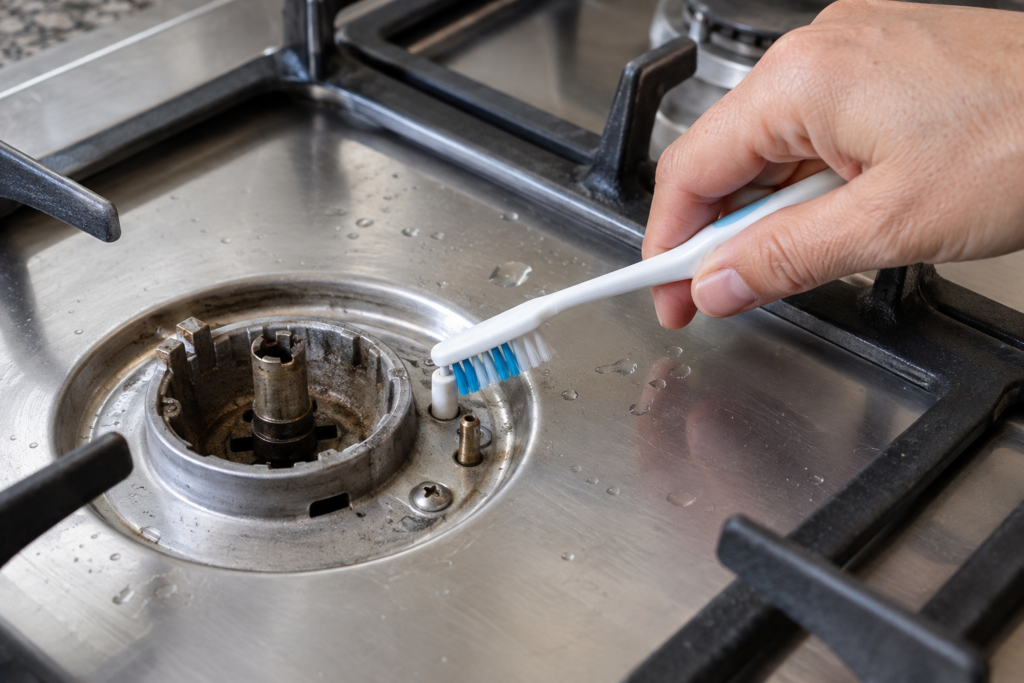
How Do You Clean the Igniter and Burner Cap?
With the cooktop off and fully cool, lift off the grate and the burner cap, clean the electrode and the cap with a soft toothbrush and warm soapy water, and let everything dry completely. This is the same sequence the cooktop F9 and rangetop E1 pages recommend.
- Turn everything off and let it cool before touching a burner.
- Remove the grate and the burner cap and set them aside.
- Clean the electrode with a soft toothbrush and warm soapy water, or a dry then slightly damp cloth.
- Clear the port holes with a straightened paper clip, held perpendicular so the openings are not enlarged.
- Dry every part completely, then reseat the cap flat and centered.
Never use steel wool or an abrasive pad on the ceramic igniter. It damages the insulating material and makes the sparking worse. If the flame still fails, our rangetop E1 page and the cooktop F9 page describe the next checks, including confirming that the gas shut-off valve is fully open.
What to Check After Cleaning
Before you call anyone, give the burner a fair test. Put everything back, make sure the cap is sitting flat and fully seated, turn the knob and watch. A good result is a quick light and silence. If it lights but clicks on, the cap or a damp electrode is the usual reason, and a second, patient drying often finishes the job.
- Let it dry for a while. Water trapped under the cap can keep a spark leaking for several minutes.
- Test each burner, not only the one that was misbehaving; neighbors often share the same cause.
- Listen for the pattern. One burner clicking points at that burner; all of them points at the supply or the module.
What Keeps It From Coming Back?
Small habits, mostly. Wiping spills while they are fresh stops a film from forming on the electrode, and drying the burner area after cleaning prevents the dampness that makes a spark leak. A cap that is reseated flat after every cleaning is the single most useful habit, because an off-center cap causes more trouble than a dirty one.
- Wipe boilovers early, once the surface has cooled, rather than after they bake on.
- Keep water away from the igniter when you clean around the burners.
- Reseat caps flat and check that they sit level after every lift.
- Clear the port holes monthly if you cook with a lot of oil or sauces.
- Cover a spill, not the burner: pots with proper lids keep boilovers off the igniter.
Households that cook a lot of sauces, frying or long simmers will need to do this more often than the occasional cook. A good rhythm is a quick wipe-down after any boilover, a proper clean of the caps and electrodes once a month, and a look at the port holes each season. It takes ten minutes for four burners, and it keeps the burners lighting at the first click, which is the real aim of the whole routine.
When Cleaning Does Not Fix It
If the electrode is clean, dry and sparking, and the burner still does not light, the spark module or the igniter has probably failed, and a failed module can also keep clicking on its own. Low gas supply pressure is another possibility, which the cooktop page suggests checking if other gas appliances in the house are also behaving oddly. These faults need a technician.
The guide to Monogram range igniter problems covers the cases where a burner simply will not light, and the rangetop igniter replacement cost shows what a replacement involves. The price is confirmed after diagnosis, with a written estimate before any part is ordered. Monogram cooktop repair covers igniters and modules, and you can schedule a visit or contact us with the model and what the burner does. The Monogram range maintenance guide has a longer schedule for the whole appliance.