 Michael Turner
 Key Takeaways
- Monogram rangetop code E1 means burner ignition failure — usually a worn igniter, not a gas supply problem.
- Monogram rangetop igniter replacement cost starts from $95 for the diagnostic visit that confirms the exact cause.
- A careful cleaning of the ceramic electrode resolves a meaningful share of clicking complaints without any part replaced.
- A single igniter is inexpensive to replace, and repairing one is almost always worth it over replacing the rangetop.
- Cooktop E1 is a different code on Monogram's induction line — same letters, unrelated part.
The Bottom Line
Monogram rangetop igniter replacement cost starts from $95 for diagnosis, and a single igniter is one of the least expensive parts to fix on a professional rangetop — try cleaning first, then repair rather than replace the appliance.
A Monogram professional rangetop burner that clicks continuously, even after the flame has caught, or will not light at all, is usually reporting E1 to the control board. The Monogram rangetop igniter replacement cost is one of the more predictable numbers on this site, because the fault points squarely at one part rather than a group of possible causes.
| Symptom | Cause | Typical fix |
|---|---|---|
| Burner clicks after flame is lit | Igniter not sensing flame correctly | Igniter replacement |
| Burner will not light at all | Igniter failure or gas supply issue | Diagnose before replacing |
| One burner affected, others fine | Localized igniter or electrode fault | Single igniter replacement |
| All burners clicking | Spark module or wiring issue | Broader electrical diagnosis |
What Does the Monogram Rangetop E1 Code Mean?
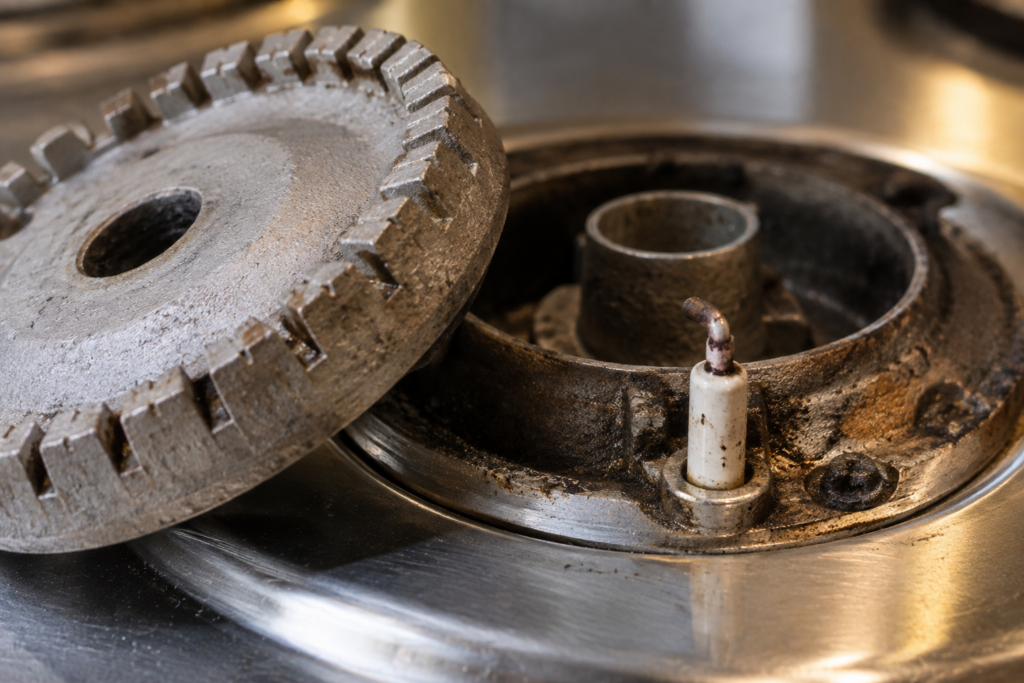
E1 means burner ignition failure — the spark module is not confirming a successful light within the time the control allows. On a professional-style gas rangetop, the igniter is a small ceramic electrode mounted next to each burner head, and it does two things: it generates the spark, and depending on the model, its circuit also confirms the flame caught. When either job fails, the control keeps clicking past the point where a normal light would have taken hold, which is exactly the symptom that sends owners searching for this code.
Rangetop Igniter Replacement Cost Breakdown
Diagnostic work on a Monogram rangetop ignition fault starts from $120, and that visit confirms whether the fault is a single worn igniter, a buildup issue rather than a part failure, or a wiring fault feeding the spark module. A single igniter is one of the less expensive parts on a professional rangetop to replace, and the labor is straightforward on most models since the burner head lifts off to expose the electrode. The exact total is confirmed in writing after diagnosis, before the part is ordered.
- Single igniter replacement is the most common outcome and the least expensive of the group.
- Spark module replacement is needed less often, when multiple burners click at once.
- Wiring repair is the least common cause but the one most likely to be mistaken for a bad igniter, since the symptom looks identical from the stovetop.
Can You Clean the Igniter Instead of Replacing It?
Sometimes, and it is worth trying before booking a repair. Food residue, grease, and moisture from boil-overs are a frequent, non-mechanical cause of a clicking igniter, and a careful cleaning resolves a meaningful share of these calls without a part being replaced at all.
- Turn off the gas supply to the rangetop before touching anything near the burner heads.
- Remove the burner cap and head and inspect the ceramic electrode for visible grime or moisture.
- Clean gently with a dry brush — never a wire brush, which can chip the ceramic and create a new fault.
- Let everything dry fully before reassembling and testing, since residual moisture reproduces the same clicking symptom.
If clicking continues after a careful cleaning, the electrode itself has likely cracked or worn out, and that is a part replacement rather than a cleaning job.
Identifying Which Burner Needs the Igniter Replaced
Test each burner individually rather than assuming the whole rangetop shares the fault. Turn each knob one at a time and listen — a clicking sound that continues well past the point a flame would normally catch on that specific burner is the one with the failed or fouled igniter, while burners that light promptly are unaffected. This matters for cost as much as for diagnosis, since a single confirmed igniter is a much smaller repair than replacing the spark module that serves every burner.
- One burner clicks, others light fine: localized igniter fault — the least expensive outcome.
- Multiple burners click together: points at the shared spark module rather than an individual electrode.
- Clicking stops the moment you release the knob: often a switch contact issue rather than the igniter itself.
- Burner lights but with a delay every time: a weakening igniter that has not failed completely yet, worth addressing before it does.
- Igniter sparks visibly but no flame catches: points at the gas supply to that burner rather than the igniter itself, and is worth checking before ordering any part.
Testing each burner separately before booking a repair also helps set expectations for cost — a technician arriving already knowing which burner is affected can usually complete a single-igniter replacement in one visit rather than needing a second trip to track down the fault first. Keep in mind that a burner sitting unused for a long stretch, such as one at the back of the rangetop that rarely gets cooked on, is more likely to accumulate the moisture and residue that mimics a failed igniter, simply because it never gets the periodic use that would otherwise clear light buildup on its own.
Is It Worth Repairing a Rangetop Igniter on an Older Unit?
Almost always yes. An igniter is an inexpensive, well-defined part failure on a rangetop that otherwise represents a significant investment, and there is essentially no scenario where replacing the whole rangetop over a single igniter fault makes financial sense. This is different from a broader repair-or-replace decision on the rangetop as a whole — our guide to Monogram cooktop repair or replace covers that wider question for when several systems are aging at once, but a single stuck igniter on an otherwise healthy rangetop is not that scenario.
A related fault worth knowing about while you have the burner head off is cooktop E1 on Monogram's induction line — a different code on a different appliance despite sharing the same letter and number, since a rangetop and a cooktop are separate product lines on this site with separate parts. Igniter trouble on the freestanding range line is covered separately in our Monogram range igniter problems guide, which walks through the same symptom on a different product family.What a Rangetop Igniter Repair Visit Includes
A technician tests each burner's spark individually, inspects the electrode for cracking or contamination, and checks the wiring harness back to the spark module before replacing anything. Our rangetop repair service covers the igniter, the spark module, and the gas valve assembly together in a single visit. Schedule a visit or reach out with the symptom and we will confirm what to expect for your specific model before anyone comes out. A rangetop that clicks on every burner at once, rather than just one, is worth mentioning specifically when you book — it changes which part a technician expects to bring, and can shorten the visit considerably.
Most igniter visits are completed the same day, since the part rarely needs to be special-ordered and the burner head comes off without disturbing the gas line itself. If a burner has been clicking for weeks before you book, mention how long it has been happening — an igniter that has been struggling for a long stretch sometimes shows secondary wear on the electrode housing that a fresh failure would not, and knowing that in advance helps a technician bring the right parts on the first visit rather than a second one.