 Michael Turner
Key Takeaways
- The site puts Monogram professional ranges at fifteen to twenty years or more, so most single-part rangetop faults are worth repairing.
- Clicking that continues after the flame is lit points at the igniter module or its switch.
- Anything touching the gas path, such as valves, orifices or supply connections, is a technician job.
- Check the knobs are fully off before treating an E5 code as a failed sensor.
- Corrosion, warping or several failures at once are the signs a rangetop is past saving.
The Bottom Line
Repair a Monogram rangetop for an igniter, valve or control fault while the body and burners are sound, and think harder when several parts fail together. The price is confirmed after on-site diagnosis, with a written estimate before work begins.
A professional rangetop is a gas surface built to commercial standards, installed in a countertop and priced accordingly. That changes the repair question: the machine is expensive to replace, simple in what it does and hard to substitute, so most faults are worth fixing. This guide is about the rangetop specifically; for a Monogram range with an oven, the general advice is in our Monogram range worth-repairing guide.
| What you notice | Likely part | Worth repairing? | Who does it |
|---|---|---|---|
| Burner clicks but will not light | Dirty or wet burner, igniter electrode or spark module | Yes | Cleaning yourself, parts by a technician |
| Clicking continues after the flame is lit | Igniter module or switch | Yes | Technician |
| Flame will not go out at off | Gas valve control | Yes, stop use first | Gas technician |
| Rangetop refuses to start with an E5 code | Knob not seated, or knob sensor | Yes | Check the knobs, then a technician |
| Erratic output or E7 | Control board | Usually yes | Technician |
Is a Monogram Rangetop Worth Repairing?
Usually yes, because the faults are mostly small parts on a machine built to last. The site's range guide says Monogram professional ranges are designed for fifteen to twenty years or more of residential use, and it gives no separate figure for rangetops, so read that as a rough guide. For a Monogram rangetop worth repairing means one whose burners, grates and body are sound and whose fault is an igniter, a valve or a control. A repair of that kind is rarely close to the cost of a new rangetop.
The exception is a rangetop that has failed in several places at once, or one whose body is corroded or warped. In that case a single repair buys little, and the larger decision is covered in the Monogram range repair or replace guide.
Why Does a Monogram Rangetop Keep Clicking After Use?
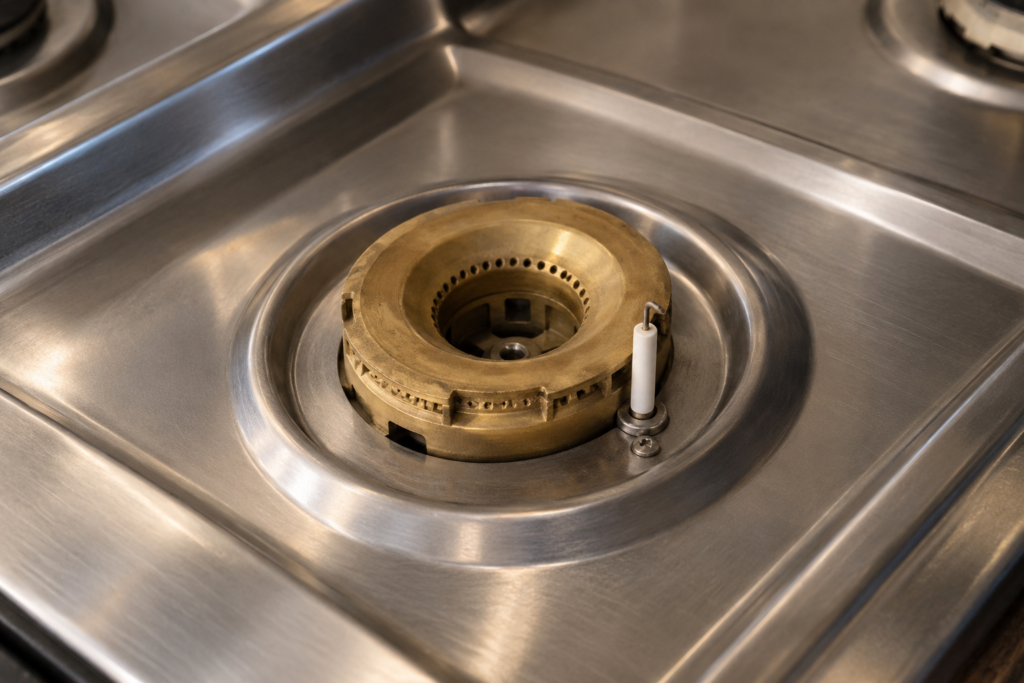
A burner that keeps sparking after the flame is lit points at the igniter module or its switch, according to the site's rangetop repair page. The igniter should stop clicking once a flame is detected, and a module that does not stop is reading the situation wrongly or has a sticking contact. It is a small repair, but it should be done, because a clicking igniter also tells you the system has lost track of the flame.
- Clicking while the flame burns. The igniter module or switch is the usual suspect.
- Clicking from a burner you did not light. Moisture or spilled liquid around the electrode, so dry it and the cap.
- Clicking and no flame. See the E1 page for the ignition failure checks.
Which Rangetop Repairs Are Worth Paying For
These repairs restore full function on a machine that is otherwise sound, and none of them points at a failing rangetop.
- Igniter or electrode. The E1 page lists a failed electrode or spark module as a cause, and cleaning clears many cases.
- Gas valve control. The E3 page treats this as a stop-use fault, and the repair is worth doing properly.
- Knob position sensor. The E5 page says a knob not fully seated is the commonest cause, so check the knobs first.
- Control board. The E7 page describes a memory fault that a breaker reset can clear if it is transient.
- Burner cleaning. A packed or damp burner head is the cheapest fix of all, and it is yours to do with the cap off and the rangetop cold.
The cost of igniter work is covered in our Monogram rangetop igniter replacement cost guide.
Warning Signs That Mean Stop Using the Rangetop
Most rangetop faults are an annoyance, but a few are not, and they are worth knowing before you decide anything about the cost. The site's code pages treat them as stop-use faults, and none of them is a case for a quick home fix.
- A flame that will not go out. The E3 page says to shut off the gas supply if the flame does not extinguish at off.
- A gas smell with no burner on. Leave the house and call the gas utility from outside.
- A burner that lights by itself. A stuck-open valve fault, per the E3 page.
- A yellow or orange flame. The rangetop repair page ties it to the wrong air and gas mix.
Any of these ends the question of whether it is worth repairing for now: the rangetop is unsafe, and the repair is not optional. After the repair the same question comes back, and the answer is usually still yes.
What Gas Work Must a Technician Do?
Anything that touches the gas path: valves, orifices and the supply connection. The site's range guide says all repairs involving gas valve components, burner orifices or supply line connections must be done by a qualified technician, for safety and in most places by code. Cleaning a burner cap and drying an electrode are yours; opening the gas path is not.
If you smell gas at any time, do not use switches or a phone inside, leave the house and call your gas utility from outside. Shut off the supply only if you can do so quickly and safely on your way out.
How Old Is Too Old to Repair a Rangetop?
Age matters less on a rangetop than on most appliances, because it has no compressor, no pump and no water path. A rangetop that is fifteen years old with sound burners and a sound body is still a repair candidate, and a younger one with corrosion around the burner bases is not. Look at the metal, the grates and the burner heads before you look at the calendar, and run a hand along the burner bases to feel for rough or flaking spots under the grates.
Ask the technician which parts are original and which have been replaced, because a rangetop that has already had a valve and a module changed has less hidden wear than one that is still on every original part. Count the repair history as well. Three repairs in a year, or a repeat of the same fault, suggests something systemic such as a wet burner area, a failing control or a gas supply issue, and that is worth a full inspection before another part goes in.
What to Do Before You Book
Note which burner misbehaves, whether it clicks, lights or goes out, and any code on the display. Take the cap off and dry it, and check the knobs are fully in the off position. The Monogram range igniter problems guide covers the checks in more detail. Monogram rangetop repair covers igniters, valves and controls. The price is confirmed on site after diagnosis, with a written estimate before work begins; schedule a visit or contact us with the model number and the burner affected.