 Michael Turner
 Key Takeaways
- SY EF on a Monogram refrigerator means the evaporator fan has stopped, so cold air is not circulating and both compartments warm.
- A diagnostic visit starts from $120, credited toward the repair, with the final price confirmed in writing.
- SY EF is not always a new motor: ice on the blade, a wiring fault or the control board output are the other causes.
- Ice on the blade often comes from a defrost fault, which is repaired alongside the fan or the fan will stall again.
- Move perishables promptly, and discard thawed meat, poultry and seafood.
The Bottom Line
The Monogram evaporator fan motor replacement cost starts from $95 for diagnosis, and the final figure depends on whether the motor, the ice, the wiring or the board is at fault. On a sound built-in, the repair is almost always worth doing.
A Monogram refrigerator that slowly warms in both compartments, sounds oddly quiet and shows SY EF is telling you the evaporator fan has stopped. That fan is the one that moves cold air from the coil into the cabinet, so without it nothing circulates, and food starts to warm. The Monogram evaporator fan motor replacement cost is a contained repair, but not every SY EF ends in a new motor, and the difference decides the bill.
| Cost factor | What it changes |
|---|---|
| Diagnostic visit | Separates a seized motor from ice, wiring or the board |
| Fan motor part | Varies by model and by built-in or column platform |
| Labor to reach the fan | The rear freezer panel and the evaporator cover come off |
| Defrost repair | Added if ice on the blade came from a defrost fault |
What Is the Monogram Evaporator Fan Motor Replacement Cost?
A diagnostic visit starts from $120, credited toward the repair if you proceed, and the repair itself is priced once the technician has confirmed what stopped the fan. The motor is a modest part compared with the sealed system, but the labor includes removing the freezer rear panel and often the evaporator cover, and that work is the same whether the part is a motor or a harness.
The final figure is confirmed on site with a written estimate before any part is ordered. A code alone does not tell us whether the fan is seized, iced or simply unpowered, so quoting one number for every SY EF would be wrong about as often as it was right.
Does SY EF Always Mean a New Motor?
No, and the cheaper causes are worth ruling out first. The code page lists four possibilities: the fan motor has failed or seized, ice has built up on the fan blade, the wiring harness to the fan has a fault, or the control board output that powers the fan has failed. Only the first is a motor replacement, and the second can clear on its own after a manual defrost.
- Motor failure: windings or bearings have given up; the motor is replaced.
- Ice on the blade: often a symptom of a defrost fault, so the defrost system is checked as well.
- Wiring fault: an open circuit or damaged connector; a smaller repair.
- Board output: the relay or driver on the control board; a larger repair.
If ice is the cause, a manual defrost may let the fan resume and clear the code. If the motor or wiring has failed, the code returns immediately after any reset. Our SY EF code page lists the symptoms, and the FF page covers the frozen-evaporator code that often goes with ice on the blade.
Is It Safe to Keep Food in the Refrigerator With SY EF?
Not for long. Both compartments warm because cold air is not circulating, so move perishables to a cooler or another refrigerator and arrange service promptly. If the freezer contents have softened, discard any meat, poultry or seafood that has thawed completely.
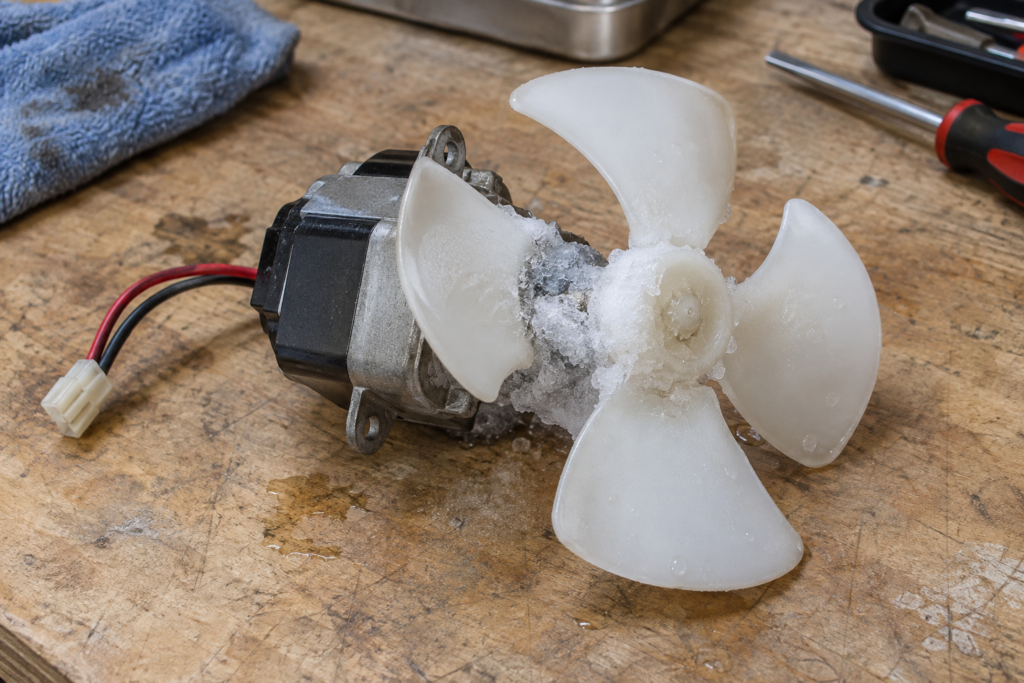
The usual story is gradual. First the freezer is a little soft at the back, then the refrigerator side drifts above its set temperature, and the compressor seems to run without achieving anything. A fan problem is the one fault where the refrigeration system works and the cabinet still does not cool, which is why it confuses people into suspecting the compressor, the most expensive part, when the cause is the cheapest one in the loop.
A Safe Listening Test You Can Do
You can tell a lot without opening anything. Open the freezer door, press and hold the door switch to make the control think the door is closed, and listen behind the rear freezer panel. A healthy evaporator fan makes a steady low hum. On Monogram models the door switch is typically a small button near the top hinge area of the freezer door frame.
- Hold the door switch and listen for the hum behind the rear panel.
- Note the quiet. No airflow sound with the compressor running points at the fan.
- Listen for scraping. A scraping or rubbing sound can be ice on the blade or a seized motor; do not force anything.
- Look at the frost. Frost only on the evaporator coil and nowhere else in the freezer is a clue that air is not moving.
Give the technician the results: it shortens the diagnosis and keeps the estimate honest.
Where the Bill Can Grow
The fan is the visible part, but the cause behind it can add work. If the blade was frozen because the defrost system failed, replacing the motor alone treats the symptom and the fan will stall again. That is the case where a second repair line appears on the estimate, and it is a legitimate one rather than an upsell.
- Defrost heater or sensor: the usual source of repeated ice on the blade.
- Water damage: a defrost drain that has backed up can wet the fan area.
- Food loss: not a repair cost, but the real price of waiting.
- Repeat visits: a motor replaced without clearing the ice source comes back as a second call.
The way to keep the bill predictable is to describe the symptoms carefully when you book: when it started, whether it follows the door being left open, whether frost is only on the coil. That gives the technician a head start on the cause and keeps the visit to one trip in most cases.
What the Visit Looks Like
Expect the technician to start with the listening test you can do yourself, then open the freezer rear panel to see the fan and the coil. A fan that spins freely by hand but does not run points at wiring or the board; one that is stiff or frozen in place points at the motor or at ice. Meters and a look at the defrost components finish the diagnosis, and the estimate follows.
- Symptom review: what you heard, when it started and how warm each compartment got.
- Panel removal: the rear freezer panel and the evaporator cover come off to reach the fan.
- Testing: motor, harness and board output are tested in turn before a part is named.
- Estimate: a written figure, confirmed before any part is ordered.
Is Repairing It Worth It on a Built-In?
Almost always, if the cabinet is otherwise sound. A fan motor is a small fraction of replacing a built-in refrigerator, and a built-in is expensive and disruptive to swap because it is fitted into cabinetry. The decision tightens only when the fan is one of several problems on an old unit. See the guide on whether a Monogram refrigerator is worth repairing for that wider comparison, and Monogram refrigerator repair costs for the overall picture.
Our Monogram refrigerator repair service covers the fan, the defrost system and the board. Schedule a visit, or contact us with what you heard and saw. If the display also shows a temperature alarm, read the HRS alarm guide as well.