 Michael Turner
 Key Takeaways
- A loose built-in handle is almost always backed-out set screws in the standoffs, not a broken handle.
- Matching gaps at the top and bottom of the hinge side are the quickest way to tell a hung door from a sagging one.
- The paper test around the gasket finds a leaking corner in under a minute and needs no tools.
- A door that is out of alignment makes the compressor run longer and can post the dE door-open code with nobody at the fridge.
- Handle screws and gasket cleaning are owner work; hinge adjustment on a panelled built-in door is not.
The Bottom Line
Tighten the handle set screws first, then compare the hinge-side gaps and run the paper test on the gasket. A door that still sags or leaks after that needs the hinge set by a technician, because a panelled built-in door is too heavy to adjust safely in place.
A handle that wobbles, a door that no longer sits flush with the cabinetry, a seal that whistles when you close it — on a built-in refrigerator these are one family of problems, not three. The handle, the hinge, and the panel all hang on the same door, and a fault in any of them changes how the other two behave. The good news is that a Monogram refrigerator door handle is one of the few parts on the machine an owner can reasonably inspect without tools.
| What you notice | Most likely cause | Where to start |
|---|---|---|
| Handle rocks side to side | Set screws in the standoffs backed out | Hex key, quarter turn each |
| Handle is firm but the door sags | Hinge cam or bushing worn | Measure the gap top and bottom |
| Door does not pull itself shut | Hinge spring or closing cam | Check swing from half open |
| Seal whistles or frosts at one corner | Door out of alignment | Paper test around the gasket |
| Alarm sounds with the door shut | Door switch or a gasket that never seats | Watch the interior light |
How a Built-In Handle Is Actually Held On
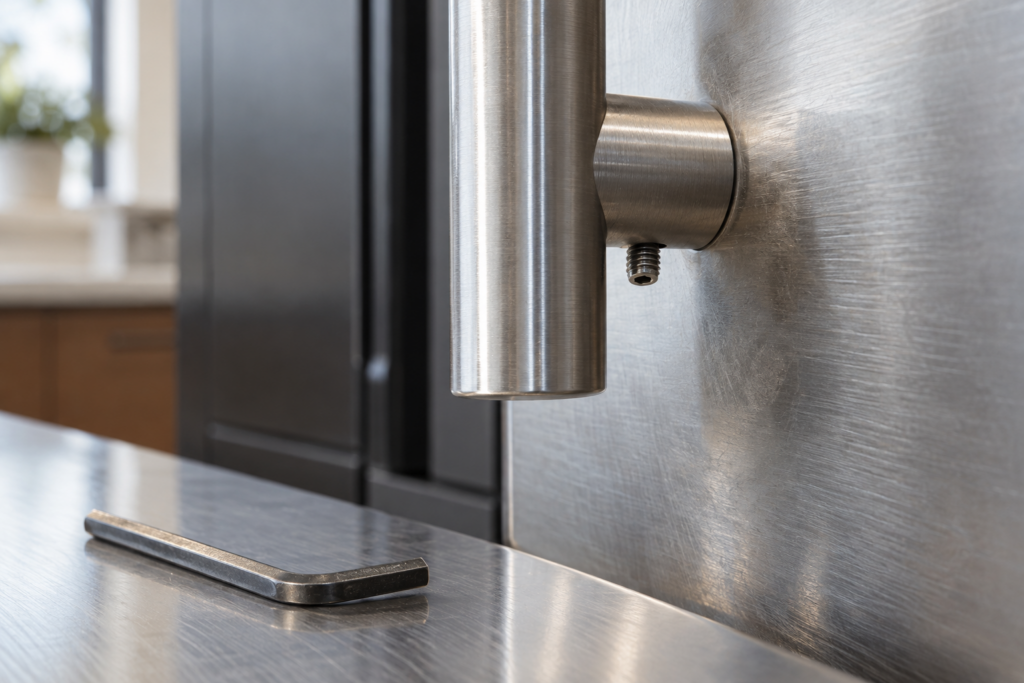
Nothing about this handle is decorative hardware. It mounts on two or three machined standoffs that pass through the door panel and thread into a reinforced plate behind it. Each standoff is locked to the handle tube by a small set screw, usually a hex socket, tucked underneath where you never see it. All of the load you apply when you pull a heavy, gasket-sealed door goes through those screws.
That is why a loose handle almost always means loose screws rather than a broken part. Years of pulling works them out a fraction at a time, the handle starts to rock, the rocking accelerates the loosening, and eventually the tube slips off one standoff entirely. Catching it at the wobble stage costs a quarter turn of a hex key. Catching it after the standoff has been deformed costs a part.
What to Check, and in What Order
Do this with the door closed and the kitchen quiet. Every step is observation, not disassembly.
- Grip the handle and try to rotate it. Any rotation at all means the set screws need attention before anything else is judged.
- Look at the gap along the hinge side, top and bottom. On a correctly hung door those two gaps match. A gap that is wider at the top means the door has dropped.
- Open the door to about halfway and let go. A healthy built-in door either holds or swings gently closed. One that falls open fast has lost its closing cam.
- Run the paper test. Close a strip of paper in the door at eight points around the gasket and pull each one out. Even drag everywhere is correct; one spot that slides free is the corner that leaks.
- Watch the interior light as the door closes. A light that stays on at the last inch means the switch never sees the door arrive, and the compartment will run warm.
Why Alignment Is Not Cosmetic
A door that hangs a few millimeters low looks like a trim problem and behaves like a refrigeration problem. The gasket is a magnetic seal with a fixed profile; it cannot stretch to cover a gap. Where it fails to seat, warm room air enters continuously, and the compartment answers by running the compressor longer.
Two things follow. The first is frost, because the moisture riding in on that air condenses and freezes on the nearest cold surface. The second is a door that the machine thinks is open for too long, which is what the dE door open too long code records. If the machine is reporting dE and nobody has been leaving the door open, look at alignment before looking at electronics.
- Sagging loads the hinge further. The bottom hinge carries almost all of the weight, and a misaligned door concentrates it on one edge of the bushing.
- Panels make doors heavy. A custom wood panel adds real mass, and the hinge adjustment that was correct on installation day may not be correct years later.
- Loose handles accelerate it. A wobbling handle transfers the pull as a twist rather than a straight pull, and the hinge absorbs the difference.
What an Owner Can Fix and What They Cannot
Tightening handle set screws is an owner job. Use the correct hex size, snug them evenly rather than driving one hard, and check them again after a week. Cleaning the gasket with warm water and drying it is an owner job too, and it fixes more sealing complaints than any adjustment.
Hinge adjustment on a built-in is not. The hinge carries a panel, a door, and a spring under tension, and the adjustment points are reached with the door supported off its mounts. A door that comes loose during that work damages the cabinetry it is set into as well as itself. Routine care that prevents most of this is covered in our Monogram refrigerator maintenance guide.
Getting It Looked At
Bring in a technician when the door sags, when the gasket fails the paper test after cleaning, or when the handle cannot be brought tight because the standoff thread has given up. Those three are the point where continuing to use the door makes the repair larger.
Our Monogram refrigerator repair service covers doors, hinges, and seals as well as the cooling system, and a service call starts from $120. The final price is confirmed after the on-site diagnosis, with a written estimate before any work begins. You can book a visit or send us the details and we will tell you whether this needs a technician at all.