 Michael Turner
Key Takeaways
- A Monogram double wall oven is usually worth fixing when the fault is in a part and the cavity and door are sound.
- Which cavity has failed tells you whether the fault is local or shared.
- Sensor, element, latch, fan and hinge repairs make sense at most ages; cavity damage does not repair economically.
- Compare the written quote with half the price of a new double oven, plus fitting and any cabinet work.
- Ask which part failed, what was tested and whether the other cavity is affected before approving the repair.
The Bottom Line
Repair a double wall oven when the fault is in a part and the oven is sound, look harder when both cavities fail or the oven is old, and always get the quote in writing. The price is confirmed after diagnosis, with a written estimate before work begins.
Owning two ovens behind one set of doors changes the repair question in two directions at once. When one cavity fails the other keeps working, so the household can wait and compare quotes. But the replacement is also bigger, dearer and more disruptive than for a single oven, because the cabinetry has been built around a tall opening. This guide is about the double wall oven in the Monogram line specifically: how to decide whether a fault in one cavity justifies a repair, when the age of the oven or the number of faults tips it the other way and what to ask a technician before approving the work.
| Situation | Usually worth fixing? | Why |
|---|---|---|
| One cavity fails, the oven is under about ten years old | Yes | The other cavity and the cutout are sound |
| A sensor, element, latch or fan fault | Yes, at most ages | Small parts against a large oven |
| A control fault on a younger oven | Usually | Compare the quote with a new double oven |
| Faults in both cavities at once | Look closely | May point to a shared cause, or to wear |
| Old oven, damaged cavity or door | Often not | Cavity damage is not repairable economically |
Is a Monogram Double Wall Oven Worth Fixing?
Usually, yes, when the fault is in a part and the oven is in good shape. The oven that earns a repair has a failed sensor, element, latch or fan, a cavity that is clean and sound, and an age within the range the site describes for Monogram wall ovens, which is 12 to 15 years of expected life. The expense of a new double oven, the fitting work and the cabinetry make repair the better value in most of those cases.
Our guide to whether a Monogram oven is worth repairing covers the general case and the 50 percent rule. This guide adds what is particular to two cavities.
Does It Matter Which Cavity Has Failed?
It matters a good deal, because it tells you whether the fault is local or shared. A code or a failure in one cavity only usually points to that cavity's sensor, element, latch or fan. A code in both at once, or a failure that moves between them, suggests something they share, which on a built-in oven is usually the control side or the supply to it.
- Note which cavity. Upper, lower or both.
- Note what each does. Does the working cavity heat normally?
- Note the code and when it appeared. At start-up, during preheat or during a cleaning cycle.
- Note any change in the other cavity. It is useful evidence for a shared fault.
The code pages on this site, such as F76 for a control communication fault, describe codes that involve the control and are worth reading before you call.
Which Repairs Make Sense on a Double Oven?
The small ones almost always do. The guide on this site lists the temperature sensor, the bake and broil elements, the door hinge or gasket and the convection fan among the repairs worth doing on most Monogram ovens. A latch fault, such as the one on the F9 page, also sits in that group, and so does a stuck key from the F7 page.
- Sensor, element, latch and fan faults. Repair, whatever the age within reason.
- Door hinge and gasket. Worth doing for energy and safety, particularly on a lower door that is used often.
- Control faults. Weigh the age and ask what exactly has failed; our guide to a Monogram wall oven control board goes through it.
- Cavity damage. Chipped enamel or a rusted interior does not repair economically.
When Does Age Tip the Decision?
Around the point where the oven is near the end of its expected life and a second fault is waiting. A single fault on a 14-year-old oven is a different question from the same fault on a 6-year-old oven, because the repaired oven has fewer years in which to recover the cost. The usual test is to compare the written quote with half the price of a new double oven, and to add the cost of fitting and any cabinet work, which on a built-in is a real number.
The cost side of that comparison is covered in the guide to Monogram oven repair costs, and the larger decision in repairing or replacing a Monogram oven.
- Under about ten years. Repair almost any fault that is in a part.
- Ten to fifteen years. Repair small parts, weigh larger ones.
- Beyond that. Consider the whole oven, the cavity and the other faults.
The Doors, the Hinges and the Cutout
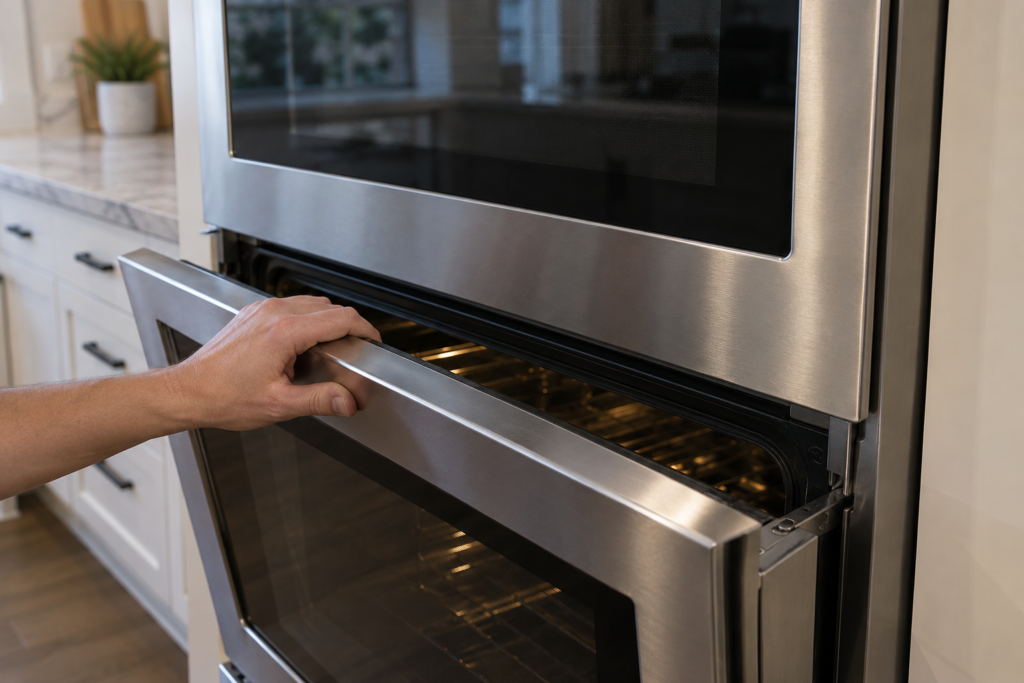
Two features of a double oven do not exist on a single one and are worth checking before you decide. The first is the lower door, which is opened more often than the upper one, carries a heavy load when it is used for roasting pans and wears its hinges and gasket faster. A lower door that no longer closes squarely or a gasket that has hardened wastes heat into the cabinetry, and fixing it is among the repairs the site marks as worth doing on any oven under about twelve years old.
The second is the cutout. A built-in oven is sized to its opening, and replacing it means a unit that fits the same dimensions, with the same trim, the same electrical connection and often some cabinet adjustment. That is the real cost of replacing a built-in, and it is why a repair that looks large on its own can still be the cheaper choice. If you are thinking of replacing the oven in any case, look at the installation requirements first, because a different model may not drop into the same opening.
- Check the lower door seal and hinge. Close the door on a sheet of paper and look for even contact.
- Look at the gaskets on both doors. Brittle or flattened rubber loses heat.
- Measure the cutout before comparing replacements. The opening decides what fits.
What to Ask Before Approving the Repair
A written estimate that lists the part, the labor and any related items lets you answer the question yourself. Ask which cavity the fault is in, whether the other cavity needs anything, and whether the part is on hand. A diagnostic visit for a Monogram appliance starts from $120, with the final price confirmed after diagnosis and a written estimate before any work begins.
- Which part, and why that one? What was tested to reach that conclusion.
- Is the other cavity affected? A fault that may spread changes the estimate.
- Is a second visit needed? The part may have to be ordered.
- What is the condition of the cavity and door? It is part of the decision.
To arrange a visit, schedule a repair or read about Monogram oven repair.