 Michael Turner
 Key Takeaways
- CC on a Monogram refrigerator is a compressor control fault, but only a failed compressor puts the sealed system itself on the table.
- An inverter board, a start relay or the main control board are electronics outside the sealed loop and are repaired, not replaced with the unit.
- A built-in is costly and awkward to replace, so a compressor repair on a sound, younger unit is often the better choice.
- Check ventilation before condemning the compressor; poor airflow can trip the thermal protection and show CC.
- Move perishables at once, since food reaches unsafe temperatures within about four hours.
The Bottom Line
Monogram refrigerator sealed system repair or replace is decided by where the CC fault sits: electronics are repaired, and a failed compressor on an older unit is the case for replacing. The price is confirmed after diagnosis.
When a Monogram built-in refrigerator stops cooling in both compartments and shows CC, the word that follows the diagnosis is usually "compressor," and the next word is usually "replace." That jump is premature. The refrigerator's cooling loop, known as the sealed system, is only part of what CC can point at, and the decision between repair and replacement depends on which part of the loop or its controls failed.
| Fault behind CC | Inside the sealed system? | Repair or replace |
|---|---|---|
| Inverter board (compressor driver) | No, it is electronics | Repair; the cabinet is fine |
| Start relay or overload protector | No, an add-on part | Repair; the smallest cost |
| Main control board fault | No, it is electronics | Repair; check age first |
| Compressor failure | Yes | Weigh against age and the 50 percent rule |
What Is the Sealed System on a Monogram Refrigerator?
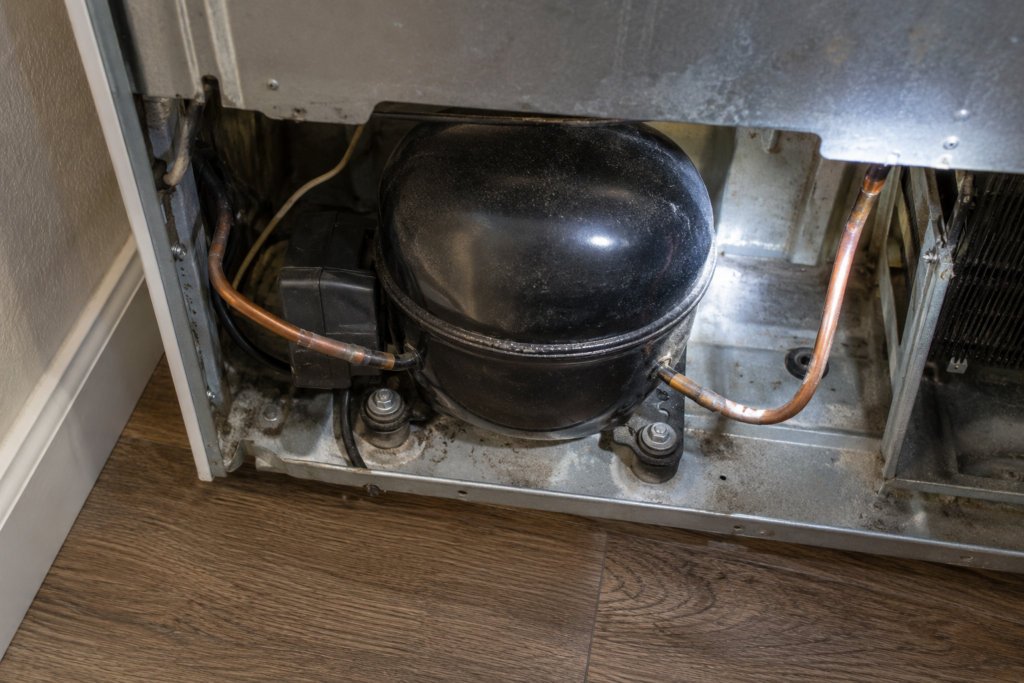
The sealed system is the closed refrigerant loop: the compressor, the condenser, the evaporator and the lines between them. It is called sealed because nothing in it is meant to be opened in normal life, and work on it needs specialized tools and the proper handling of refrigerant. That is why repairs inside the loop cost more than repairs to the fans, the board or the sensors around it.
A CC fault is a compressor control fault. The compressor is not running, neither compartment is cooling, and food reaches unsafe temperatures within about four hours, so move perishables at once. The CC code page lists the causes and the safe checks.
Monogram Refrigerator Sealed System Repair or Replace: Where the Fault Sits
Decide by where the fault sits, not by the code. The code page names four causes: an inverter board failure, a compressor failure, a start relay failure on older non-inverter models, and a main control board fault. Three of the four are electronics or add-on parts outside the sealed loop, and they leave the cabinet and the refrigerant system untouched. Only a compressor failure puts the loop itself on the table.
- Inverter board: units with variable-speed compressors use a separate driver, and replacing it is a contained repair.
- Start relay: on older models, a small part that is cheap compared with the unit.
- Control board: a repair, but it raises the age question.
- Compressor: the heavy case, and the one where replacement becomes a real option.
Is a Failed Compressor Worth Repairing on a Built-In?
Sometimes, and more often than on a freestanding unit, because a built-in refrigerator is costly to replace and fitted into cabinetry. A compressor repair on a Monogram built-in under roughly ten years old, with the cabinet and the door seals in good condition, is often the better choice. On a much older unit, particularly one with a second fault, the arithmetic changes, and owners searching for the cost of rebuilding a cooling system are usually weighing just this.
The rule of thumb is the one used elsewhere on this site: repair if the estimate is under about half the cost of a comparable new unit, and count installation, trim and cabinet work on the replacement side. The final price is confirmed on site after diagnosis, with a written estimate. The whole-appliance version of this decision is in our guide to repair or replace a Monogram refrigerator.
It also helps to think about the age of the unit separately from its condition. Built-in refrigerators are designed for long service, and a Monogram that has been well ventilated, kept clean at the condenser and never short of airflow often outlasts the average. A unit that has lived in a tight, hot enclosure is older than its date. Tell the technician about the setting as well as the years.
How Do You Tell an Inverter Board From a Failed Compressor?
You usually cannot from the outside, and a technician tests the board before condemning the compressor. A compressor that does not hum or vibrate at the rear bottom of the unit is consistent with either, since an inverter board failure also leaves it silent. The tests that separate them are done with a meter on the board output and the compressor windings.
- Check the ventilation first. The page asks for about an inch of clearance at the sides and two at the rear, and a top grille not blocked by cabinet trim.
- Note whether the condenser fan runs. It may stop with the compressor, since both follow the same signal.
- Do not rely on a reset. A power cycle can clear CC for a while, but a true hardware fault returns at once.
- Ask for the board to be tested before a compressor is quoted.
A compressor that overheats because of poor airflow can shut down on thermal protection and trigger CC without being faulty, which is why ventilation comes first. The nearby CF page covers the condenser fan fault, which can cause overheating of its own.
Ask the technician one more question when a compressor is on the table: is the compressor itself the problem, or is something upstream causing it to overwork? A condenser fan that has stopped, or dust packed around the condenser, can overheat a compressor and shorten its life, and a replacement installed without fixing that cause fails early. The answer shapes the quote, and it is one of the strongest reasons to prefer a full diagnosis over a quick guess.
- Condenser fan running: airflow over the condenser is working.
- Condenser clean: dust has not insulated the coil.
- Ventilation clear: nothing around the unit is trapping heat.
Finally, ask how the work will be warrantied. A sealed system repair is substantial, and the owner is entitled to know what is covered, for how long, and what would void it. A clear answer in the written estimate is a good sign that the shop stands behind the work, and it belongs in the comparison with a new unit, whose warranty is also part of its price.
What Replacement Involves on a Built-In
Replacing a built-in is more than a delivery. The old unit has to be removed from its enclosure without damaging the cabinetry, the new unit has to match the cutout, and panels, trim and water and power connections need attention. A like-for-like replacement is simpler than a change of size or style, which often leads to carpentry.
- Matching the opening: a different width or depth means altering the cabinet.
- Panels and trim: custom panels from the old unit may or may not carry over.
- Connections: the water line, the power supply and the leveling need to be redone.
Those costs sit on the replacement side of the comparison, and they are the reason repairing a good built-in is often sensible. Compare the estimate with our Monogram refrigerator repair costs guide, then book Monogram refrigerator repair. For tall column units the column refrigeration repair service applies, and you can schedule a visit or contact us with the code and the age of the unit. The HRS alarm guide explains what to do with the food while you decide.