 Michael Turner
Key Takeaways
- A condenser fan fault means the compressor and coils are overheating, and the CF page says not to use the unit until it is repaired.
- A fan motor is replaced, not repaired: a stiff or grinding blade points to the bearings, and a free blade with a dead motor points to the motor or its capacitor.
- Clean the condenser area first, with the unit unplugged, because dust and debris stall fans.
- Wiring and board faults are not motor problems and are technician repairs.
- The age of the refrigerator rarely changes the answer for the fan alone, but earlier overheating of the compressor can.
The Bottom Line
Clean the condenser area, replace the fan motor if the blade is stiff or the motor is dead and have a technician check the wiring and board if neither explains it. The price is confirmed after diagnosis, with a written estimate before work begins.
The condenser fan is a small part with a large job. It pulls air across the condenser coils and the compressor so that the heat the refrigerator removes from your food goes somewhere, and when it stops, the compressor overheats and cools less and less. That makes a condenser fan fault the kind of repair that looks minor and behaves like a major one: the part itself is modest, but the consequence of leaving it is the compressor. This guide covers Monogram refrigerator condenser fan repair or replacement: what to try first, when the motor itself has to go and the point where the age of the refrigerator changes the answer.
| What you find | Repair or replace? | Why |
|---|---|---|
| Dust or an object stalling the blade | Clean it out, no part needed | The motor itself may be fine |
| Blade stiff or grinding by hand | Replace the fan motor | The bearings have failed |
| Blade spins freely but the motor does not run | Replace the fan motor | A motor or capacitor failure |
| No voltage at the fan connector | Look at the wiring or the board | The motor may be fine |
| Fan fixed but the compressor has overheated repeatedly | Check the cooling system | Damage may already be done |
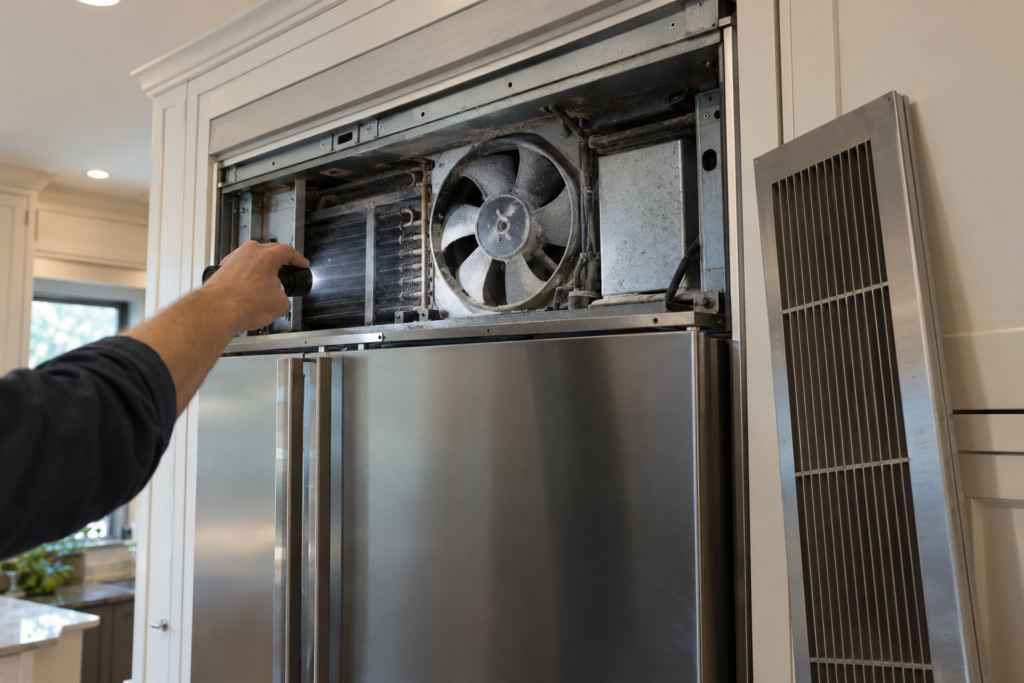
What Does a Condenser Fan Fault Mean on a Monogram Refrigerator?
It means the control has detected that the condenser fan is not running at the expected speed, or has stopped, and the compressor and coils are being left to overheat. The CF page treats it as a high-severity code. It says the compressor will repeatedly shut down on thermal protection, that cooling will be inadequate and that the unit should not be used until it is repaired.
The page lists four causes: a failed fan motor, which it calls the most common, debris on the blade, a wiring fault at the motor and a failure of the output on the main control board. The first two are in the fan. The last two are not, which is why a diagnosis is worth having before any part is ordered.
Should You Repair or Replace the Condenser Fan Motor?
Replace it, if the motor has failed. A fan motor is a sealed part, and there is nothing to repair in a motor whose bearings have seized or whose windings have opened. The decision that remains is whether to replace the motor alone or to deal with whatever caused it to fail, which is often dust, a stalled blade or a restricted airflow. A new motor behind the same clogged grille will fail again.
- Clean first. Vacuum the area around the fan with a long brush and clear anything in the way of the blade.
- Replace if the blade is stiff. The page says a stiff or grinding blade points to the bearings.
- Replace if the blade is free but the motor is dead. That is a motor or capacitor fault.
- Stop at wiring or board faults. Those are not motor problems and are not DIY repairs.
What Can You Check Yourself?
A cautious owner can do two safe checks and nothing more. Both are on the page and neither involves opening the electronics. The first is cleaning the condenser area, which on built-in Monogram models the page places at the top rear, after unplugging the unit and removing the vent panel or the base grille. The second is turning the fan blade by hand with the unit unplugged, to feel whether it spins freely or grinds.
The page also lists a voltage check with a multimeter. That is a technician's test: it means working near live wiring on a heavy built-in unit, and a wrong reading can send you to the wrong part.
- Unplug the refrigerator first. Always, even for a vacuum.
- Do not force the blade. A stiff blade is a diagnosis, not an obstacle to push through.
- Do not run the unit with the fan stopped. The compressor can overheat.
- Move the food if the interior is warming. A cooler with ice buys time for the visit.
What a Technician Will Look At
A visit for a CF code is mostly about narrowing the four causes to one. The technician starts with the fan area and the blade, which settles the debris and the bearings in a few minutes. If the blade turns freely, the next questions are electrical: whether power is reaching the motor, whether the harness is intact and whether the board is sending the output at all. Only then is a part ordered, and the written estimate names it.
- The fan and the blade. Debris, free movement and the sound of the bearings.
- Voltage at the motor connector. Correct voltage with a dead motor means the motor; none points to the wiring or the board.
- The compressor. Any sign of heat damage from running without the fan.
- The airflow path. A blocked grille or enclosure that caused the stall in the first place.
The last item is the one owners overlook. A fan that fails once in a clean, open installation is a part failure. A fan that fails in a boxed-in installation will fail again, so the repair is not finished until the airflow is.
Does the Age of the Refrigerator Change the Answer?
Rarely for the fan alone. A fan motor is one of the more modest parts in a built-in refrigerator, set against the price of a new built-in unit, its installation and the cabinetry around it, so repair is the right call at almost any age if the rest of the system is sound. The age matters when the fan fault has already cost the compressor something, or when several faults arrive together. For that wider question, see our guide to repairing or replacing a Monogram refrigerator, and for the costly end of it the guide to the sealed system.
- Fan fault, no other symptoms. Replace the motor.
- Fan fault after weeks of poor cooling. Ask the technician to check the compressor.
- Several faults, an older refrigerator. Compare the quote with the replacement in full.
Keeping It From Happening Again
By keeping the air path clean and clear. Dust is the most common reason a fan stalls or a motor works too hard, and the fix is the routine that the maintenance guide sets out: vacuum the condenser area every three months and keep the base grille free. The clearances in the compressor clearance notice matter for the same reason.
When you book, give the technician the code, the model number and what you tried. A diagnostic visit for a Monogram appliance starts from $120, with the final price confirmed after diagnosis and a written estimate before any work begins. Schedule a visit or read about Monogram refrigerator repair.