 Michael Turner
Key Takeaways
- The Monogram oven thermal limit replacement cost depends on why it tripped, not on the part alone.
- A thermal limit is meant to trip; replacing it without finding the cause means it trips again.
- The notice lists a failed fan, blocked vents, heavy grease on self-clean and surges as causes.
- Do not reset it yourself on a heavy built-in oven; a limit that trips twice needs a diagnosis.
- Never bypass the limit; it is the last protection against an overheated oven.
The Bottom Line
Treat a tripped thermal limit as a symptom, and ask for the cause on the written estimate before approving a part. The price is confirmed after on-site diagnosis, and no work starts before you approve it.
A thermal limit is a small safety part with a large reputation. When a Monogram oven loses heat suddenly, often with no code on the display, the thermal limit is a common suspect, and the first question owners ask is what replacing it costs. The part is a modest one. The honest difficulty is that the part itself is rarely the bill: the cause of the trip and the work of reaching it decide the price. This guide sets out what drives a Monogram oven thermal limit replacement cost and why a quote should start with a diagnosis.
| Item | What it covers | Starting point |
|---|---|---|
| Diagnostic visit | Finding why the oven lost heat or tripped | from $120 |
| Thermal limit itself | The part, when it has failed or will not reset | Priced after diagnosis |
| Access to the rear of the oven | Pulling a built-in oven from its opening | Priced after diagnosis |
| The cause behind the trip | A fan, a sensor or a board, if one failed | Priced after diagnosis |
| Written estimate | Part, labor and access listed separately | Before any work begins |
How Much Does a Monogram Oven Thermal Limit Replacement Cost?
The figure we can state before a technician sees the oven is the diagnostic visit, from $120. A Monogram oven thermal limit replacement cost beyond that depends on whether the limit has really failed, what tripped it and how much work it takes to reach it, and that price is confirmed on site after diagnosis, with a written estimate before any part is ordered. We do not publish a flat figure for the part, because an owner who sees one tends to expect it to be the whole bill.
The reason is in the order of events. A thermal limit is designed to trip. The notice on this site describes it as a safety device that interrupts power to the heating elements if the oven reaches an unsafe temperature. A device that has done its job is not a failed device, so replacing it without finding out why it tripped means the oven will trip again.
What Trips a Thermal Limit in the First Place?
The thermal limit notice lists five conditions, and each one points at a different repair, which is why the cause matters more than the part.
- Self-clean with heavy grease. Running the cycle on an oven with built-up grease can push the cavity past its limit.
- Long high-heat baking with blocked vents. Heat that cannot leave collects in the cabinet.
- An enclosed space with poor ventilation. Installation and clearance, not a part, are at fault.
- A failed oven fan. The notice names fan failure as a cause of heat concentrating in the cavity.
- Power surges or fluctuations. A voltage event during high-temperature operation can trip the limit.
Only some of these end in a new part. A blocked vent or a dirty cavity needs cleaning, not replacement, and a technician can say which applies after a quick diagnosis.
Should You Reset the Thermal Limit Yourself?
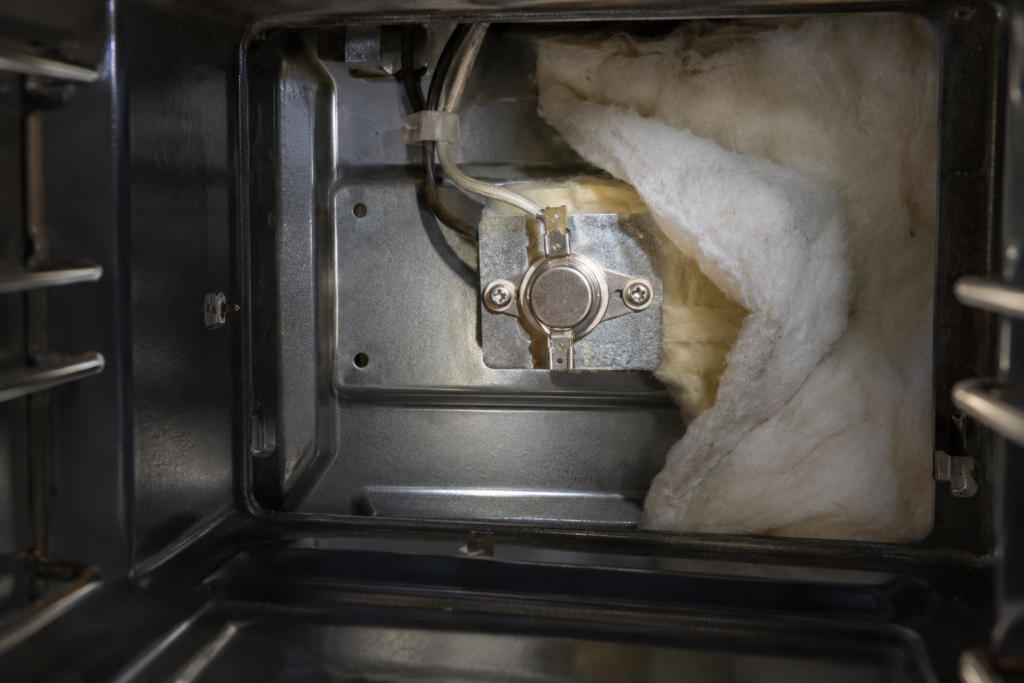
We would not advise it, even though the notice describes a manual reset on some models. The notice's own steps start with letting the oven cool for at least an hour with power off, then pulling the oven away from the wall to reach the rear panel, and it warns that the oven is heavy and calls for help. That is a job near live wiring on a heavy built-in appliance, and the notice also says that if the limit trips again you should not reset it a second time without finding the cause.
The useful part of the notice is its last point: a limit that trips more than once indicates a problem with the cooling fan, the temperature sensor or the control board that needs professional diagnosis. If your oven has tripped once and recovered, note the date and what you were doing. If it trips again, stop and book a visit.
- Write down the date and the setting. A trip during self-clean points somewhere different from one during a long roast.
- Note whether the display still lit. A dead display points at power, and a lit one at the heating circuit.
- Do not try the oven again to see. The notice's advice is to find the cause first.
What Moves the Price of the Visit
Three things, and the part is the smallest. The cause of the trip decides whether the visit ends with a cleaning or with a second repair. The access decides labor: a built-in wall oven may need to come out of its opening, and our Monogram oven repair costs guide notes that a double wall oven is a two-person job, so confirm that the quote counts for it. The model decides which part fits.
- Cause. Cleaning a cavity costs less than replacing a fan or a sensor on top of the limit.
- Access. Single and double wall ovens, and ranges, are reached differently.
- Model. The part for your oven is identified by the model number on the door frame label.
- A second fault. A tripped limit can arrive together with an F2 over-temperature code.
Does a Tripped Limit Mean the Oven Is Unsafe?
It means the oven overheated once, and until the cause is known you should not keep running it to find out. Our guide to the Monogram oven F2 over-temperature error describes the stop-and-call response to a genuine over-temperature event, and the same caution applies here: do not run a test bake to see whether it happens again, and do not start a self-clean cycle.
The limit is the oven's last line of defense. Anything that bypasses it, whether a jumper wire, a taped reset or a part that is not specified for your oven, removes the one protection that stops an overheated oven from becoming a fire. A technician will refuse to fit one, and so should anyone you hire.
How to Keep the Quote Honest
Ask for the cause in writing, not only the part. A fair quote lists the diagnosis, the part, the labor and any access charge as separate lines, and says what was found that made the limit trip. If the answer is "it just tripped," ask what was tested.
- What was tested. The fan, the sensor and the board should each have been ruled in or out.
- Whether the limit was the fault. A limit that tripped as designed may not need replacing at all.
- What stops a repeat. Cleaning, clearance or a second part, named in the estimate.
Keep the estimate with your records. If the oven is a double wall oven, ask whether the quote includes the extra person needed to move it, because that is the line most often left out and the one that changes the total.
When you are ready, Monogram oven repair covers thermal faults, fans, sensors and boards. The price is confirmed on site after diagnosis, with a written estimate before work begins; schedule a visit or contact us with the model number and what the oven was doing when it lost heat.