 Michael Turner
 Key Takeaways
- Check a Monogram wall oven recall with the model and serial number, never with the product name alone.
- Search under Monogram, GE Monogram and GE, and compare each hit against your own model number.
- A fault code such as F2, F4 or F8 is a repair question, not evidence of a recall.
- If a notice says to stop using the oven, stop; if it names one function, avoid that function.
- Photograph the label and keep the date and source of the check with your appliance papers.
The Bottom Line
Find the label, search under every name the line uses and keep a record; a fault code is a repair, not a recall. We do not summarize individual notices; a repair price is confirmed after diagnosis, with a written estimate before work begins.
A built-in wall oven is installed once and used for years, which makes a recall question unusual: nobody remembers the model number, and the label can be hard to reach in a cabinet that was fitted around the oven. The check is simple once you have the label, and it is worth doing before you spend money on a repair, because a manufacturer's remedy is normally free of charge.
| Your question | Where the answer is | What you need |
|---|---|---|
| Is my oven named in a recall? | The official recall list and the manufacturer's notices | Model and serial number |
| Is it safe to use tonight? | The interim advice in the notice | The notice, read in full |
| Is it simply faulty? | The code page for the code on the display | The code and what the oven was doing |
| Who fixes it? | The manufacturer for a recall, a technician for a fault | The written remedy or estimate |
How Do You Check a Monogram Wall Oven Recall?
Find the model and serial number, then compare them with the manufacturer's recall information and the official consumer product recall list. Write both numbers down exactly, since a notice may be defined by model and by build date, and two ovens with the same product name can sit on different sides of it.
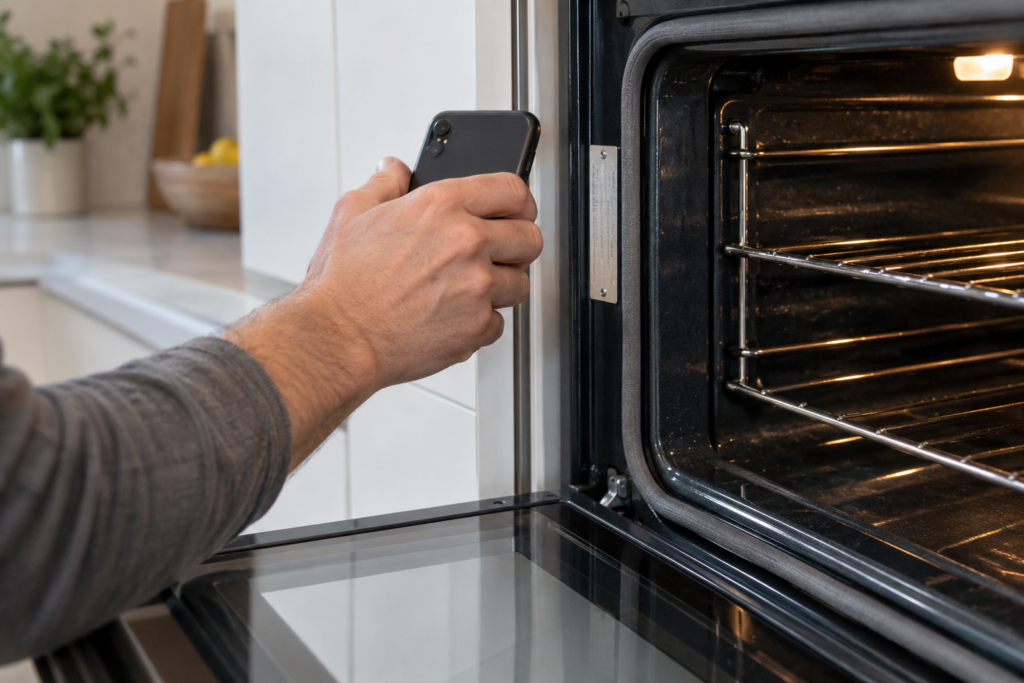
The label location varies by model, and in a built-in installation it can be hard to reach. If you cannot see it with the door open, the owner's manual, the installation paperwork and the purchase receipt will carry the model number. A photograph of the label taken now saves a second search later. On a double wall oven, record the model once and note both cavities, because the check is for the appliance, not for each oven.
Which Name Should You Search Under?
Search under more than one. Monogram is the premium line of the GE family, and this site names its appliances GE Monogram, so a notice may be filed under Monogram, under GE Monogram or under GE. Search each spelling and each product type, such as wall oven, double wall oven and range, and compare any hit against your own model number, not against the product name. A search that returns nothing under one name is not a clear result until the others have been tried as well.
- By product type. Try wall oven, double wall oven, built-in oven and, if yours is a combination, microwave and oven.
- By model prefix. The first letters of the model number identify the product family, so a notice that lists prefixes is easy to match.
- By build date. Many serial numbers carry the manufacturing date (your owner's manual explains how to read yours), and a notice limited to a date range is a miss if yours falls outside it.
We do not summarize individual notices on this site, because the notice is the authority and it is revised. This guide is about how to check, not about any one campaign.
A Recall Notice and an Oven Fault Code Are Different Things
A recall is a defect in a model range with a remedy from the manufacturer. A fault code is one oven wearing out or failing, and it is a repair. Several oven codes on this site say to stop using the oven, and none is evidence of a recall.
- F2. The oven passed its over-temperature limit; the F2 page covers the stop-use advice.
- F3 and F4. The temperature sensor circuit is open or shorted, and the F4 page covers the shorted case.
- F8. The self-clean door lock has failed, which is a self-clean problem and not a baking one; the F8 page explains.
If a code appears and your oven also turns out to be on a notice, follow the notice and tell us what the display showed. Our Monogram oven F2 guide covers the over-temperature case in full.
Can You Keep Using the Oven While You Wait?
Follow the notice. If it says to stop using the oven, stop. If it names one function, such as the door lock or a heating mode, avoid that function and use the others only if the notice allows. If it gives no interim advice, treat the hazard it describes as the guide and ask the manufacturer's contact for the instruction in writing.
- Do not leave it on unattended. A hazard is worst when nobody is in the room.
- Stop at any burning smell. Switch off the dedicated breaker and do not restart it.
- Keep the area clear. Nothing stored on or against the oven, and nothing left inside it.
- Keep the clearances open. The installation guide sets the gaps around a built-in oven, and they must stay clear.
Why Check Before Paying for a Repair
A recall check costs nothing and takes minutes, and it changes what a repair visit should be. If an oven is named in a notice, the manufacturer supplies the remedy, and paying a technician for the same defect is money spent twice.
- The remedy is normally free. A notice describes a repair, a part or a refund offered at no cost to the owner.
- Ask before any work. If a notice applies, ask the manufacturer whether work done by someone else affects the remedy.
- Prior repairs count. Tell the technician if the oven has had work done for the same symptom, so the record is complete.
- A clean result is still useful. Knowing the oven is not named lets you treat any fault as an ordinary repair.
Do not let the check delay the response to an obvious fault, though, and do not treat a clean result as a clean bill of health for the oven. If the oven shows a stop-use code, switch it off first and check afterward, because a code that says stop is more urgent than a search that can wait until the next morning.
Wall Oven Habits That Matter Either Way
Whether or not a notice applies, a built-in oven is safest on its own circuit and with an installation that has not been disturbed. Our Monogram dedicated circuits guide explains why, and the Monogram oven safety guide covers the everyday risks. A recall check is a one-off, but these habits last as long as the oven does.
What Should You Write Down?
Keep a short record, because a built-in oven outlives the paperwork around it. Photograph the label, note the date and the source of your check, and save any reference number a notice gives you. Check again if you buy a house with an oven already in it, after a kitchen remodel or when a new item appears in the news.
The price of any repair is confirmed after on-site diagnosis, with a written estimate before work begins. Oven repair covers the faults above, and you can schedule a visit or contact us with the model number and what the oven did.